
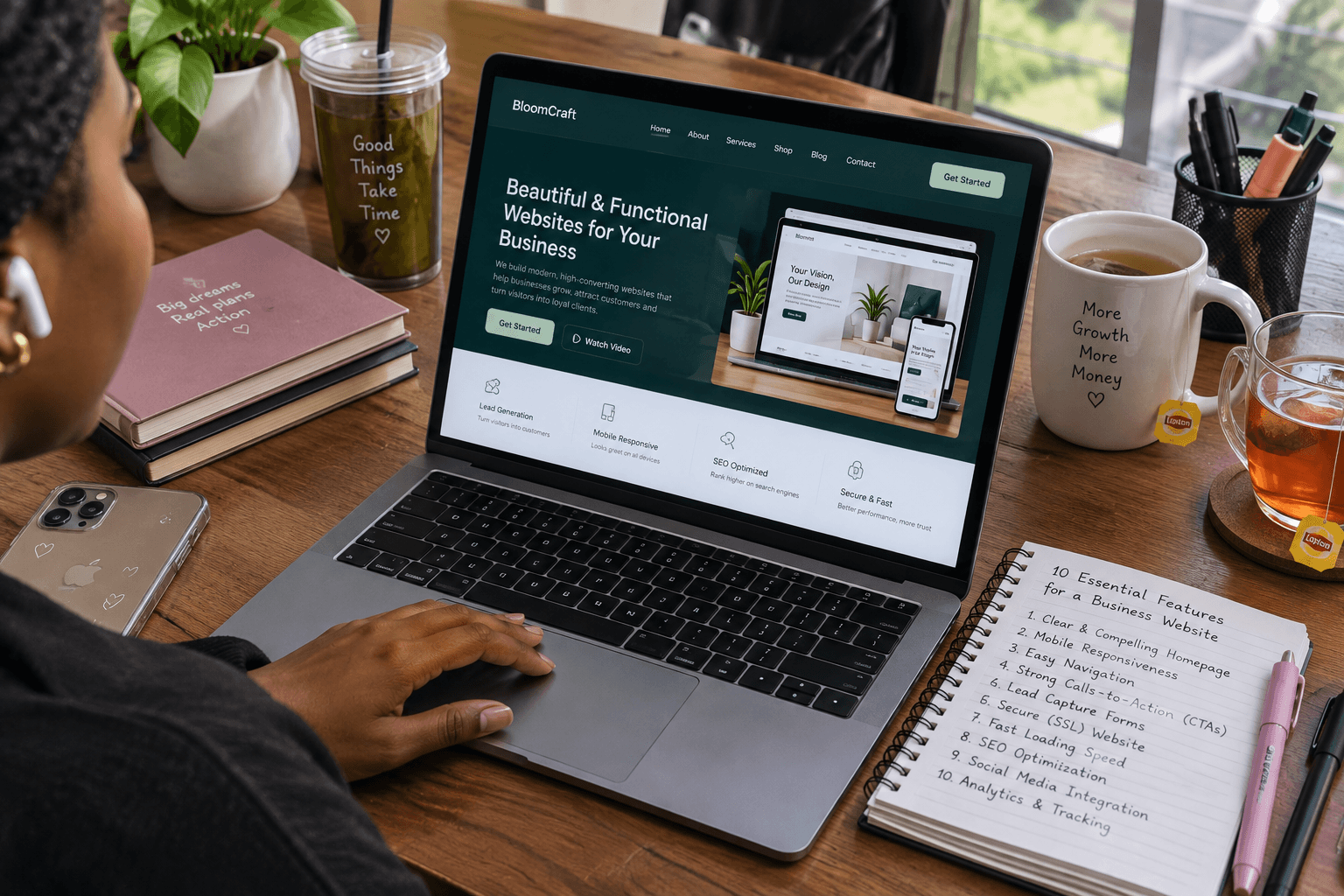
How to Build a Business Website: 10 Essential Features That Drive Leads and Sales in 2026
September 25, 2026 · by Kabirat O.
Is Your Business Website Actually Bringing You Customers?
Having a website is no longer enough. Your business website should do more than display your company name, services, and contact details. It should help potential customers find you, understand what you offer, trust your business, and take the next step. A well-built website can support lead generation, increase sales, improve online visibility, and make it easier for customers to interact with your business.
So, what does a business website need to achieve these results in 2026?
A business website is an online platform that represents a company and provides information about its products, services, brand, and operations. It also gives visitors ways to take action, such as making a purchase, requesting a quote, booking a service, or contacting the business. A good business website can help you:
- Generate leads and enquiries
- Increase sales and conversions
- Build trust and credibility
- Improve your search engine visibility
- Explain your products or services
- Reach customers beyond your physical location
- Provide information 24/7
Your website is often one of the first places potential customers go to learn about your business. This makes its design, content, speed, and usability important to your overall digital presence. For more information on how Google evaluates website experience, visit: https://developers.google.com/search/docs/appearance/page-experience
Why Your Website Matters More Than Ever in 2026
Customers now have many ways to discover a business. They may find you through Google, social media, online reviews, advertisements, or recommendations. But before making a purchase or contacting a company, many people still visit its website to find out more. A website that is confusing, outdated, slow, or difficult to use can make potential customers leave before they ever contact you. On the other hand, a professional website can help your business:
- Make a strong first impression
- Build customer confidence
- Generate enquiries
- Showcase products and services
- Answer common customer questions
- Compete with similar businesses
- Turn online visitors into paying customers
The goal is not simply to have a website. The goal is to have a website that works for your business.
10 Features Every High-Converting Business Website Should Have
Start With a Homepage That Gets to the Point
Your homepage is usually the first page visitors see, so they should understand your business within a few seconds. Instead of using vague headlines like “Welcome to Our Website,” clearly explain what you do and who you help. Your homepage should include:
- A clear headline
- A short description of your business
- Your main products or services
- Key benefits
- A clear call-to-action
- Trust signals such as reviews or client logos
For example, instead of saying: “Welcome to XYZ Solutions.” You could say: “Custom Software Solutions That Help Growing Businesses Work Smarter.”
The second option immediately tells visitors what the company does and why it may be useful to them.
Make It Easy to Use on Any Device
People do not only browse websites from computers. Many visitors use smartphones and tablets. A mobile-friendly website should adjust properly to different screen sizes. Text should be easy to read, buttons should be easy to tap, and users should not have to constantly zoom or scroll sideways. Google also uses the mobile version of a website for indexing and ranking through mobile-first indexing. Learn more: https://developers.google.com/search/docs/crawling-indexing/mobile/mobile-sites-mobile-first-indexing
A responsive design is therefore important for both user experience and search visibility.
Speed Matters More Than You Think
Nobody likes waiting for a website to load. Large images, unnecessary scripts, poor hosting, and unoptimized code can make a website slow. When visitors have to wait too long, they may leave before seeing your products or services.You can test your website speed with Google Page speed Insights: https://pagespeed.web.dev
Some simple ways to improve website speed include:
- Compressing large images
- Removing unnecessary plugins and scripts
- Optimizing website code
- Using reliable hosting
- Enabling browser caching
- Using a content delivery network when necessary
A faster website creates a smoother experience and gives visitors less reason to leave.
Tell Visitors What to Do Next
A website should not leave visitors wondering what to do after reading a page. This is where calls-to-action (CTAs) come in. A CTA tells visitors what action they should take next.
Examples include:
- Get a Quote
- Book a Consultation
- Request a Demo
- Contact Us
- Start Your Project
- Buy Now
- Learn More
The CTA should match the purpose of the page. For example, a service page could encourage visitors to request a quote, while a product page could use “Buy Now.” Clear CTAs can help move visitors from simply browsing your website to becoming leads or customers.
Keep Your Navigation Simple
Visitors should be able to find important information without struggling.
A simple navigation menu might include:
- Home
- About
- Services
- Products
- Case Studies
- Blog
- Contact
You do not need to put every page in the main menu. Focus on the pages visitors are most likely to need. A simple navigation structure also helps search engines understand how the different pages on your website are connected.
Build a Website Search Engines Can Understand
A beautiful website is not very useful if potential customers cannot find it. This is where search engine optimization (SEO) comes in. An SEO-friendly website should have:
- A Relevant keywords
- Clear page titles
- Proper headings
- Descriptive URLs
- Useful and original content
- Internal links
- Descriptive image alt text
- Mobile-friendly pages
- Good page experience
You can learn more from Google's SEO Starter Guide: https://developers.google.com/search/docs/fundamentals/seo-starter-guide
For example, a company offering custom software development could create pages targeting searches such as “custom software development services” or “business software development.” The key is to create content around what your potential customers are actually searching for.
Give People Reasons to Trust Your Business
People are more likely to contact a business when they feel confident about it. Your website should show visitors that your business is legitimate and capable of delivering what it promises.
Useful trust signals include:
- Customer testimonials
- Reviews
- Case studies
- Client logos
- Certifications
- Awards
- Industry experience
- Team information
- Results from previous projects
For example, Digisperts showcases case studies with measurable results, including a 95% reduction in order cancellations for one retail project and a 35% reduction in patient no-shows for a healthcare project.
You can explore more examples here: https://www.digisperts.com/resources/case-studies
Real results can be much more convincing than simply telling customers that your business is “the best.”
Turn Website Visitors Into Leads
Getting website traffic is good, but traffic alone does not grow a business. You also need a way to turn visitors into potential customers. Lead generation forms can collect useful information such as:
- Name
- Email address
- Phone number
- Company
- Service required
- Project details
However, avoid asking for too much information. A long and complicated form can discourage people from completing it. For many businesses, a simple form asking for basic contact information and the customer's needs is enough to start the conversation.
Give Visitors Useful Information
Your website should answer the questions customers already have. This is why useful content is an important part of business website development. A company can create blog posts, guides, FAQs, case studies, and service pages around topics its customers search for. For example, a software development company could publish articles about:
- How much custom software costs
- Custom software vs off-the-shelf software
- Signs your business needs automation
- How to choose a software development company
- Benefits of business process automation
This type of content can attract people who are searching for solutions and introduce them to your business before they are ready to buy.
Track What Visitors Are Doing
You cannot improve what you do not measure. Website analytics can show you where visitors come from, which pages they visit, how long they stay, and what actions they take. For example, analytics can help you discover that:
- A blog post brings thousands of visitors but no enquiries.
- A particular service page generates most of your leads.
- Mobile users leave a page more often than desktop users.
- Visitors reach your contact page but do not complete the form.
You can use Google Analytics to monitor website performance: https://analytics.google.com
The information you collect can help you make better decisions instead of making website changes based only on assumptions.
How to Build a Website That Actually Generates Leads
A high-performing business website should guide visitors through a simple journey:
Discover → Understand → Trust → Take Action
First, people need to discover your business through search engines, social media, referrals, or other channels.
Next, your website should help them understand what you offer.
Then, testimonials, case studies, useful content, and clear information can build trust.
Finally, a strong CTA should make it easy for them to take action.
If one part of this journey is missing, you may lose potential customers.
Common Website Mistakes That Can Cost You Customers
Even a professionally designed website can perform poorly when important details are ignored. Some common mistakes include:
- Slow loading pages
- Poor mobile experience
- Unclear homepage messaging
- Complicated navigation
- Weak or missing CTAs
- Outdated information
- Long and confusing forms
- Poor SEO
- No customer reviews or proof
- Not tracking website performance
The good news is that you do not always need to rebuild your entire website to fix these problems.
How to Improve an Existing Business Website
If you already have a website, start by identifying the biggest problems.
Check your:
Website speed: Are pages loading quickly?
Mobile experience: Is the website easy to use on a phone?
Content: Can visitors quickly understand what you offer?
Navigation: Can people find important information easily?
SEO: Can search engines understand and discover your pages?
Conversion: Are visitors actually contacting you, booking services, or making purchases?
Analytics: Do you know which pages and channels are bringing results?
Fixing the biggest problems first can sometimes produce better results than immediately starting an expensive website redesign.
Key Benefits of a Well-Built Business Website
A properly designed website can help your business achieve several important goals.
More Leads
Clear CTAs and simple contact forms make it easier for visitors to become potential customers.
Better Search Visibility
SEO-friendly content and website structure can help your business appear when potential customers search for relevant products or services.
Stronger Credibility
Testimonials, case studies, reviews, and clear business information can make visitors feel more confident about choosing you.
Better Customer Experience
Fast loading pages, simple navigation, mobile responsiveness, and useful content make it easier for customers to interact with your business.
Long-Term Growth
Your website can continue attracting visitors, educating potential customers, and generating leads even outside normal business hours.
Frequently Asked Questions(FAQs)
What are the most important features of a business website?
The most important features include a clear homepage, mobile-friendly design, fast loading speed, simple navigation, strong CTAs, SEO-friendly structure, trust signals, lead generation forms, useful content, and analytics.
How does a business website generate leads?
A business website generates leads by attracting visitors through search engines and other channels, explaining the company's services, building trust, and providing clear ways for visitors to contact the business or request a service.
How can I make my business website more SEO-friendly?
Use relevant keywords naturally, create useful content, optimize page titles and headings, improve website speed, make your website mobile-friendly, use descriptive URLs, add internal links, and make your pages easy for search engines to understand.
Why is mobile-friendly design important for a business website?
A large number of people browse the internet using mobile devices. A mobile-friendly website makes it easier for these visitors to read content, navigate pages, complete forms, and take action.
How often should a business website be updated?
There is no single update schedule for every website. However, businesses should regularly review their content, services, contact information, security, performance, and SEO. New content should also be added when it provides genuine value to customers.
Do I need a new website if my current one is not generating leads?
Not necessarily. First, identify the problem. Slow speed, unclear messaging, poor SEO, weak CTAs, difficult forms, or poor mobile experience may be responsible. Fixing these issues may improve performance without requiring a complete rebuild.
Final Insight
A business website should not exist simply because every company is expected to have one. It should have a purpose. From your homepage and navigation to your SEO, content, CTAs, lead forms, and analytics, every part of your website should help visitors move closer to becoming customers. If your current website is not generating the results you want, start by identifying what is holding it back. Sometimes, a few strategic improvements can make a bigger difference than starting from scratch. If you need a business website built around your goals, customers, and growth plans, Digisperts can help.
Explore Digisperts:
https://www.digisperts.com
Your business website should do more than look good. It should work for your business.