
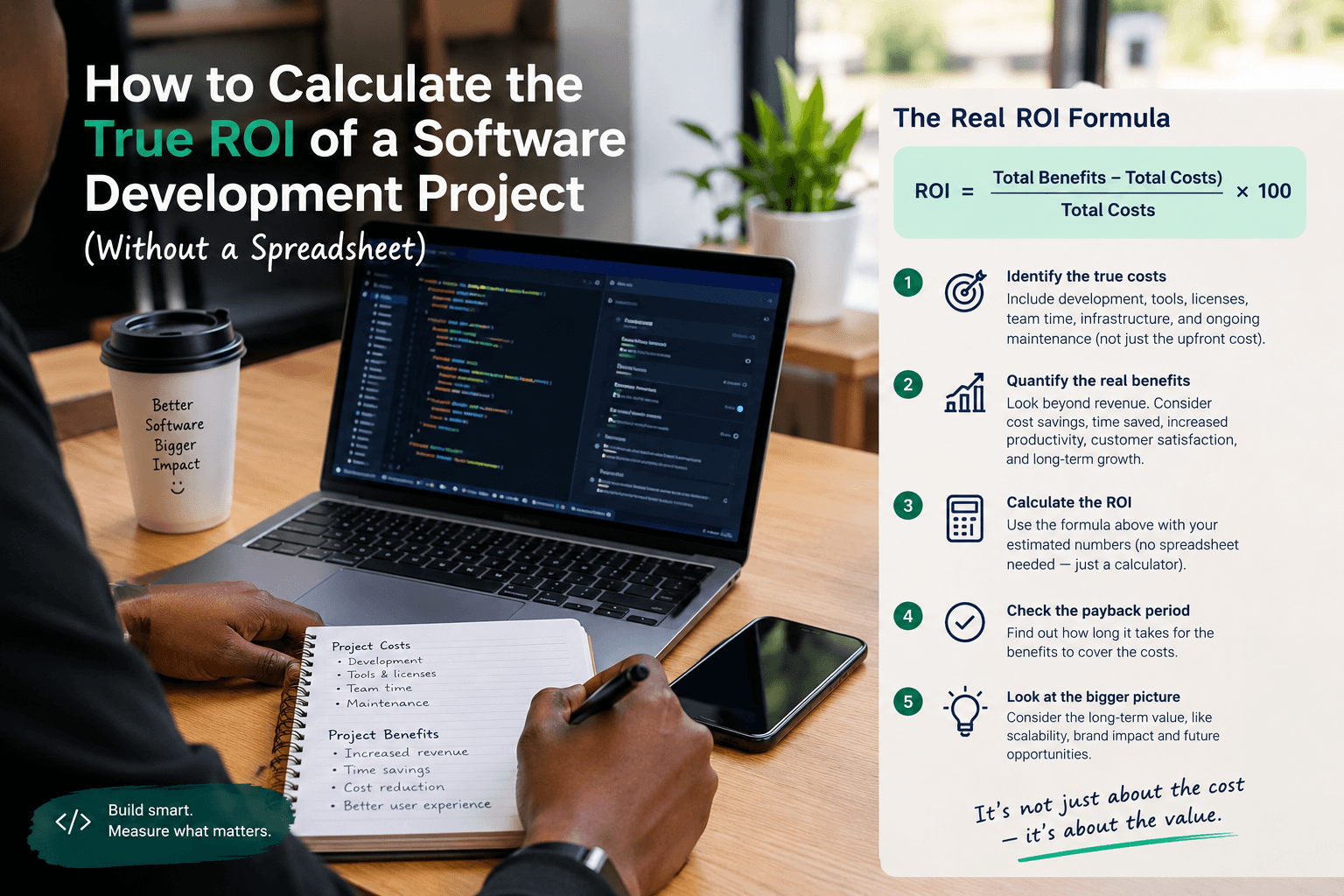
How to calculate the true ROI of a software development project (without a spreadsheet)
September 25, 2026 · by Kabirat O.
A practical guide to measuring the real business value of custom software from costs and revenue to productivity, risk reduction, and long-term growth.
A software project can be completed successfully and still be a bad investment. The app works. The features are live. The development team delivered. But did the software actually create value for the business?
That is what software development ROI helps you answer.
You don't need a complicated spreadsheet filled with financial formulas to get started. The true ROI of a software project comes down to understanding three things: what the business invested, what changed after implementation, and what those changes are actually worth.
What Is the True ROI of a Software Development Project?
The true ROI of a software development project is the measurable business value created by the software compared with the total cost of building, implementing, and maintaining it.
The basic formula is:
ROI = (Total Benefits − Total Costs) ÷ Total Costs × 100
For example, if a business invests $100,000 in a software project and receives $160,000 in measurable benefits:
ROI = ($160,000 − $100,000) ÷ $100,000 × 100 = 60%
The formula is simple. The real challenge is identifying the true costs and the true benefits.
Understanding the Total Cost of a Software Development Project
The development budget is rarely the complete cost of a software project. A business may also spend money on:
- UI and UX design
- Quality assurance and testing
- Cloud infrastructure
- Third-party APIs and software tools
- Data migration
- Security
- Employee training
- System integration
- Maintenance and support
- Internal staff time
This is why businesses should think about the total cost of ownership, not just the amount paid to build the application.
For example, a company may spend $60,000 developing custom software, then spend another $20,000 on infrastructure, integrations, training, and first-year maintenance. The actual investment is therefore $80,000 not $60,000. Businesses planning custom applications should consider the entire software lifecycle, from strategy and development to testing and long-term maintenance. Learn more about Digisperts' software development services here: https://www.digisperts.com/what-we-do/software-development
How Software Development Projects Create Business Value
Software doesn't have to directly generate sales to produce a positive ROI. A successful project can create value through revenue growth, cost reduction, productivity improvements, reduced risk, and faster business operations.
Revenue Growth
Software may help a business:
- Convert more customers
- Process more transactions
- Retain customers longer
- Launch a new product or service
- Reach new markets
If additional revenue can reasonably be connected to the software, it can be included in the ROI calculation. However, businesses should avoid giving software credit for every increase in revenue. Marketing campaigns, pricing changes, and seasonal demand can also influence results.
Cost Reduction
Software often creates value by reducing the cost of existing operations.
Examples include:
- Less manual data entry
- Lower customer support costs
- Fewer repetitive administrative tasks
- Reduced dependence on multiple software tools
- Lower error-related costs
If a new system removes a recurring expense, the money saved becomes a measurable software benefit.
Productivity Improvements
Productivity is valuable, but it should be measured carefully. Imagine software saves a team 500 hours every year. The important question is not only how many hours were saved. It is what those saved hours allowed the business to do.
Did the team serve more customers? Complete more projects? Reduce overtime? Focus on higher-value work?
That is where productivity becomes measurable business value.
Risk Reduction
Some software projects create value by preventing expensive problems. Modern systems can reduce the likelihood or impact of:
- Data errors
- Security incidents
- System downtime
- Compliance problems
- Payment failures
- Operational mistakes
If a business regularly loses money because of manual errors, software that reduces those errors creates measurable value by reducing those losses.
Faster Time-to-Market
Speed can also create business value. If software allows a company to launch products faster, respond to customer needs more quickly, or release improvements with less delay, it can help the business capture opportunities earlier. DORA provides useful research and guidance on measuring software delivery performance: https://dora.dev/guides/dora-metrics
Measuring Software Performance Before and After Implementation
The easiest way to understand whether software created value is to establish a baseline. Before implementation, record the numbers that matter, including:
- Processing time
- Revenue
- Operating costs
- Error rates
- Customer retention
- Support requests
- Employee hours
- System downtime
After implementation, measure those same indicators again.
For example, before the software, a process takes 10 hours to complete. After implementation, it takes 3 hours. That represents a 70% reduction in processing time. The next question is: What is that improvement worth to the business? Perhaps the team can process more work without hiring additional employees, reduce overtime, or provide faster service to customers.
How to Calculate the Payback Period of a Software Project
ROI measures the return generated by an investment. The payback period measures how long it takes to recover the initial investment. The basic calculation is:
Payback Period = Initial Investment ÷ Monthly Value Created
Imagine a company spends $120,000 developing a software platform. The platform creates approximately $20,000 in measurable value every month.
$120,000 ÷ $20,000 = 6 months
The business could recover its initial investment in approximately six months.
Measuring Non-Financial Software Development Benefits
Not every benefit should be forced into a financial calculation. Some software improvements are better measured through performance indicators.
These include:
Customer experience: Higher customer satisfaction and retention.
System reliability: Fewer outages and failures.
Operational efficiency: Faster processes.
Scalability: The ability to handle more customers or transactions without costs increasing at the same rate.
Employee experience: Less time spent on repetitive tasks.
These benefits may eventually affect revenue and costs, but businesses should avoid assigning random financial values simply to make an ROI figure appear larger.
Software Metrics That Do Not Measure ROI
A common mistake is confusing development activity with business value. These metrics may be useful internally, but they don't automatically prove that a software project produced ROI:
- Number of features developed
- Number of lines of code written
- Number of hours worked
- Number of deployments
- Number of downloads
Instead, focus on whether people are using the software and whether it solved the business problem it was created to solve.
Did costs decrease? Did revenue increase? Did operations become faster or more reliable?
Those are the questions that reveal real ROI.
A Simple Framework for Calculating Software Development ROI
Step 1: Calculate the Total Investment
Add development costs and all additional expenses required to implement and operate the software.
Step 2: Establish the Business Baseline
Record the relevant business metrics before implementation.
Step 3: Measure What Changed
Track improvements in revenue, costs, productivity, errors, customer outcomes, and operational performance.
Step 4: Assign Realistic Value
Calculate the financial value of measurable improvements without exaggerating uncertain benefits.
Step 5: Compare Value With Investment
Use the formula:
ROI = (Total Benefits − Total Costs) ÷ Total Costs × 100
If the measurable benefits exceed the total investment, the project has generated a positive return.
Software Development ROI Calculation Example
Let's say a business invests $140,000 in a custom software project.
During its first year, the software generates:
- $100,000 in additional revenue
- $60,000 in operational savings
- $30,000 in reduced losses caused by errors
The total measurable benefit is $190,000.
The net benefit is:
$190,000 − $140,000 = $50,000
Then:
$50,000 ÷ $140,000 × 100 = 35.7%
The software project generated approximately 35.7% ROI in its first year.
How Often Should You Measure Software Development ROI?
Software ROI should be measured throughout the project lifecycle.
Before Development
Define the business problem, expected outcomes, baseline metrics, and estimated costs.
During Development
Monitor changes in budget, scope, timelines, and expected business value.
After Launch
Measure actual adoption, revenue impact, cost savings, performance improvements, and ongoing operating costs.
Frequently Asked Questions (FAQs)
How do you calculate the ROI of a software development project?
Use the formula (Total Benefits − Total Costs) ÷ Total Costs × 100.
What should be included in software development ROI?
Include all relevant project costs and measurable benefits, including development, infrastructure, maintenance, revenue growth, cost savings, and productivity improvements.
Can custom software have a positive ROI without increasing revenue?
Yes. Software can create positive ROI through cost reduction, improved efficiency, reduced errors, and lower operational risks.
What is the difference between ROI and payback period?
ROI measures the overall return generated by an investment, while the payback period measures how long it takes to recover the initial investment.
How long does it take for a software project to generate ROI?
It depends on the project's cost and the value it creates. Smaller projects may generate returns within months, while larger enterprise projects may take longer.
Work With Digisperts
The best software investment is not necessarily the one with the most features. It is the one that solves the right business problem and creates measurable value. Digisperts helps businesses approach software development with clear business goals, scalability requirements, and measurable outcomes. Learn more about Digisperts: https://www.digisperts.com/ Explore software development services: https://www.digisperts.com/what-we-do/software-development