
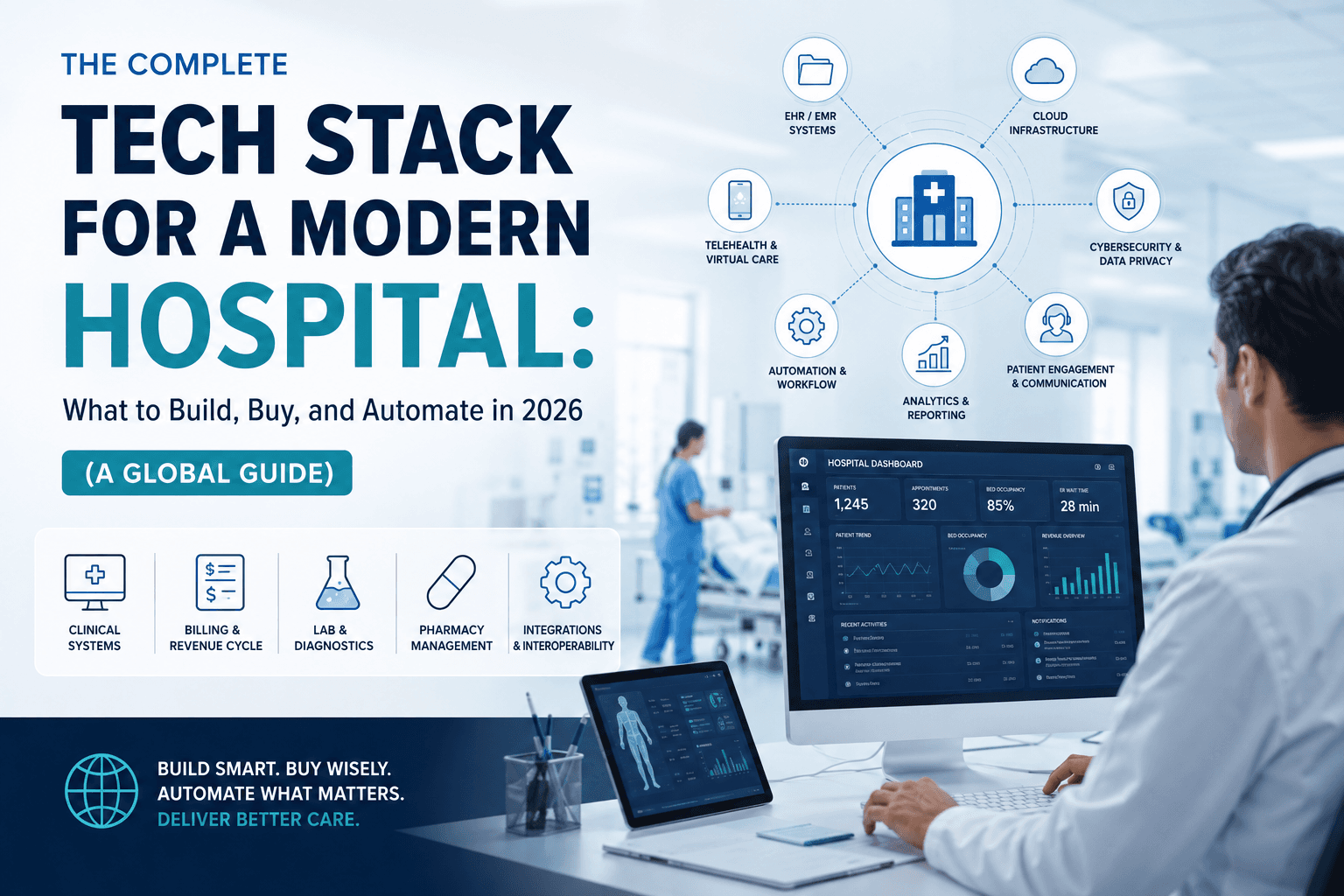
The Complete Tech Stack for a Modern Hospital: What to Build, Buy, and Automate in 2026 (A Global Guide)
August 7, 2026 · by Kabirat O.
Why Modern Hospitals Need a Strong Technology Stack
Healthcare is becoming increasingly digital. Modern hospitals now depend on technology for almost everything they do, including patient registration, medical records, laboratory testing, medical imaging, appointment scheduling, communication, payments, and healthcare data analysis.
However, having multiple digital tools doesn’t make a hospital technologically advanced.
A hospital may have several software systems and still experience challenges such as:
- Disconnected software systems
- Repeated data entry
- Poor communication between departments
- Long patient waiting times
- Security risks
- Difficulty accessing patient information
This challenge is not simply adopting more technology. The challenge is creating a connected digital environment where different systems work together effectively.
A modern hospital technology stack should improve operational efficiency, support healthcare professionals, protect sensitive patient information, and create better experiences for patients.
The important question for healthcare organizations is not only:
“What technology should we use?”
The better question is:
“What should we build, what should we buy, and what should we automate?”
What Is a Hospital Technology Stack?
A hospital technology stack refers to the combination of software, hardware, digital platforms, network infrastructure, and technologies used to manage day-to-day healthcare operations.
A modern hospital technology stack may include:
- Electronic Health Records (EHR)
- Hospital Information Systems (HIS)
- Laboratory Information Systems (LIS)
- Medical imaging systems
- Patient portals
- Mobile healthcare applications
- Telemedicine platforms
- Cloud infrastructure
- Cybersecurity solutions
- Artificial Intelligence (AI)
- Data analytics platforms
- Payment systems
- APIs and integration platforms
The success of a hospital technology stack is not determined by the number of tools a hospital uses. The real value comes from how well these technologies communicate, share information, and support daily healthcare operations.
For example:
- A laboratory system should be able to send test results directly into a patient’s medical record.
- A payment system should connect directly with the billing software.
- A patient portal should sync with appointment calendars and healthcare records.
- When systems operate separately, hospitals may experience delays, errors, and inefficient workflows.
What Hospitals Should Buy
Some healthcare technologies are too complex and specialized to develop internally. For most healthcare organizations, important systems such as Electronic Health Records, Hospital Information Systems, laboratory platforms, and medical imaging systems should generally be purchased from specialized providers.
These systems usually require:
- Advanced security features
- Healthcare industry expertise
- Regulatory compliance knowledge
- Continuous software updates
- Reliable technical support
Building these systems internally can require significant time, money, and technical expertise.
However, hospitals should not select software simply because it has the largest number of features.
Before purchasing any healthcare technology, organizations should carefully evaluate:
- Security
- Scalability (Flexibility to grow)
- Integration capabilities (How easily it connects with other tools)
- API availability
- User experience
- Data ownership
- Vendor support quality
- Total cost of ownership
A hospital should also ensure that new software can integrate with its existing technology environment.
What Hospitals Should Build
Although many healthcare systems can be purchased, hospitals may still require custom software solutions tailored to their exact style of work.
Custom development is useful when a hospital has unique workflows that existing products cannot support.
Hospitals may build:
- Custom patient portals
- Internal management dashboards
- Mobile healthcare applications
- Staff scheduling systems
- Reporting platforms
- System integration solutions
- Specialized clinical applications
For example, a hospital may buy a standard Electronic Health Record system, but build a custom dashboard that pulls live data from:
- Patient records
- Laboratory systems
- Appointment platforms
- Billing systems
This gives hospital administrators better visibility into daily operations.
Custom software also allows healthcare organizations to create solutions designed around their specific requirements.
Digisperts provides software development solutions for businesses that need custom digital platforms, applications, and software systems:
https://www.digisperts.com/what-we-do/software-development
What Hospitals Should Automate
After deciding what systems to buy and what solutions to build, hospitals should identify repetitive processes that can be automated.
Automation helps healthcare organizations reduce manual tasks, improve efficiency, and allow healthcare professionals to spend more time focusing on patient care.
Hospitals can automate processes such as:
Appointment Reminders
Patients can automatically receive reminders through:
- SMS
- Mobile applications
This can reduce missed appointments and improve scheduling efficiency.
Digital Patient Registration
Patients can complete forms digitally before arriving at the hospital.
This reduces paperwork and saves time, and improves the registration for both patients and healthcare workers.
Payment Notifications
Automated systems can send:
- Payment reminders
- Digital receipts
- Billing updates
This improves financial management and reduces administrative workload.
Inventory management
Hospitals can use automated systems to monitor medical supplies and receive alerts when stock levels are low.
Administrative Workflows
Tasks can automatically be assigned to the appropriate department or employee.
Automation helps healthcare professionals spend less time on repetitive tasks and more time focusing on patient care.
However, automation should be implemented carefully. Processes that require medical expertise and human judgment or direct patient interaction should not be automated without proper supervision.
Digisperts provides business automation solutions for organizations looking to improve repetitive workflows:
https://www.digisperts.com/what-we-do/business-automation
Technologies That Support a Modern Hospital Stack
Choosing what to buy, build, and automate is only one part of creating a successful hospital technology environment.
For these systems to deliver real value, hospitals need strong technology foundations that allow different platforms to connect, store information securely, and support better decision-making.
Some of the most important supporting technologies include:
- System integration and interoperability
- Cloud infrastructure
- Cybersecurity
- Artificial Intelligence
Integration and Interoperability: Making Hospital Systems Work Together
Modern hospitals rely on multiple digital systems, including patient records, laboratory platforms, radiology systems, billing software, and appointment management tools.
However, these systems only improve healthcare delivery when they can communicate effectively.
Interoperability allows different healthcare systems to exchange information smoothly. It reduces repeated data entry, improves access to patient information, and helps healthcare professionals make faster and more accurate decisions.
Healthcare interoperability standards such as HL7 and FHIR (Fast Healthcare Interoperability Resources) help different healthcare systems exchange healthcare information securely.
More information about HL7 FHIR: https://www.hl7.org/fhir
Similarly, DICOM (Digital Imaging and Communications in Medicine) provides standards for storing, managing, and sharing medical imaging information.
More information about DICOM: https://www.dicomstandard.org
Hospitals should consider interoperability when selecting new technology solutions. A system that cannot connect with existing platforms may create additional challenges instead of improving operations.
Cloud Technology in Modern Hospitals Technology Stack
As hospitals adopt more digital systems, they need reliable infrastructure to store, manage, and access increasing amounts of healthcare data.
Cloud computing has shifted from an emerging trend to a foundational component of modern healthcare infrastructure because it provides flexibility, scalability, and improved access to digital resources.
Hospitals use cloud technology for:
- Data storage
- Application hosting
- Backup systems
- Healthcare analytics
- Disaster recovery
- Artificial Intelligence applications
However, moving healthcare data to the cloud does not automatically guarantee security.
Healthcare organizations must still implement:
- End-to-end data encryption (at rest and in transit)
- Access controls
- Identity and access management
- Automated redundancy backup systems
- Disaster recovery plans
- Data protection policies
Sensitive patient files must remain protected regardless of whether it is stored on physical servers or cloud infrastructure.
Cybersecurity: Protecting the Hospitals Technology Stack
As hospitals become more dependent on digital systems, cybersecurity becomes a critical part of healthcare technology planning.: Protecting the Hospitals Technology Stack
Hospitals store some of the most sensitive information in the world.
This includes:
- Patient medical histories
- Laboratory results
- Personal information
- Insurance details
- Financial records
A strong hospital cybersecurity strategy should include:
- Multi-factor authentication
- Role-based access control
- Data encryption
- Network security
- Endpoint protection
- Regular data backups
- Employee cybersecurity training
Healthcare workers should also understand common cybersecurity threats such as:
- Phishing emails
- Suspicious links
- Social engineering attacks
- Weak passwords
The U.S. Department of Health and Human Services provides healthcare cybersecurity guidance here:
https://www.hhs.gov/hipaa/for-professionals/security/guidance/cybersecurity/index.html
Cybersecurity should not be treated as an additional feature added after a system has already been created.
It should be included from the beginning of every healthcare technology project.
Artificial Intelligence in Modern Hospital Technology Stack
As hospitals continue to generate more digital information from patient records, medical devices, and daily operations, the ability to analyze and use this data effectively is becoming increasingly important.
Artificial Intelligence (AI) is becoming a valuable part of healthcare technology by helping hospitals improve decision-making, reduce repetitive work, and provide better patient services.
AI can support areas such as:
- Medical imaging analysis
- Clinical documentation
- Patient communication
- Administrative automation
- Predictive analytics
- Patient triage
- Operational forecasting
However, healthcare organizations should not adopt AI simply because it is a growing trend.
Before implementing AI solutions, hospitals should consider:
- The specific problem the technology solves
- The accuracy of the system
- The quality of the data being used
- Patient privacy protection
- Human review processes
AI should support healthcare professionals rather than replace human judgment, especially in clinical decision-making.
The World Health Organization provides additional information about AI in healthcare:
https://www.who.int/teams/digital-health-and-innovation/harnessing-artificial-intelligence-for-health
How Hospitals Should Decide What to Build, Buy, or Automate
Creating an effective hospital technology stack requires careful planning. Healthcare organizations should evaluate their needs and choose the right approach for each challenge.
Build When:
Hospitals should build custom solutions when:
- The workflow is unique
- Existing products cannot solve the problem
- The solution provides competitive advantages
- The hospital can maintain the technology
Buy When:
Hospitals should purchase existing solutions when:
- The technology already exists
- Specialized expertise is required
- Security and compliance are important
- Reliable vendors are available
Automate When:
Hospitals should automate processes when:
- The task is repetitive
- The process follows predictable rules
- Manual work creates delays
- Automation can be safely monitored
The best hospital technology strategy usually combines all three approaches.
Hospitals should buy reliable core systems, build solutions for unique needs, and automate repetitive processes that improve efficiency.
Common Technology Mistakes Hospitals Should Avoid
Many healthcare organizations experience technology problems because of poor digital planning.
Buying Too Many Disconnected Systems
More software does not always mean better technology.
Hospitals need systems that communicate with each other and support smooth workflows.
Trying to Build Everything Internally
Hospitals should not spend years creating software solutions that already exist.
Core healthcare systems are often better purchased from experienced providers.
Ignoring User Experience
A system can be technically advanced but fail if healthcare workers and patients find it difficult to use.
Treating Cybersecurity as an Afterthought
Security should be considered from the beginning of every technology project.
Failing to Prepare for Downtime
Hospitals need backup plans for continuing essential services when systems become unavailable.
Adopting AI Without Proper Governance
AI systems should be carefully evaluated before being used in sensitive healthcare environments.
Frequently Asked Questions (FAQs)
What is a hospital technology stack?
A hospital technology stack is the combination of software, hardware, infrastructure, and digital tools used to manage healthcare operations and improve patient services.
Should hospitals build or buy software?
Most hospitals should buy established systems such as EHR platforms and laboratory systems while building custom solutions for unique workflows.
Why is interoperability important in healthcare?
Interoperability allows healthcare systems to exchange information, reducing duplicate data entry, delays, and errors.
How can automation help hospitals?
Automation reduces repetitive administrative tasks such as appointment reminders, notifications, workflow management, and data processing.
Why is cybersecurity important for hospitals?
Hospitals store sensitive patient and financial information. Strong cybersecurity protects this data and reduces disruption caused by cyberattacks.
How can AI be used in hospitals?
AI can support medical imaging, administrative automation, documentation, patient communication, and healthcare data analysis.
Final Insight
The best hospital technology stack is not the one with the most software.
It is the one that works efficiently.
Modern hospitals need technology that:
- Connects systems
- Protects patient information
- Reduces repetitive tasks
- Supports healthcare professionals
- Improves patient experiences
The most effective strategy is a balance between:
- Buying mature technology
- Building solutions for unique needs
- Automating repetitive processes
Healthcare organizations that carefully combine these approaches can create digital environments that are more secure, scalable, efficient, and prepared for the future.
Build Better Digital Systems With Digisperts
Digisperts helps businesses and organizations develop technology solutions through:
- Custom software development
- Business automation
- Digital transformation
- AI-powered solutions
- Software integrations
Discover business automation solutions:
https://www.digisperts.com/what-we-do/business-automation